Amiri Runway Clothing Straight Leg Jean
AMIRI: A Full Guide to Everything the House Makes in 2026
A Los Angeles luxury house, AMIRI rests on denim sanded by hand, skeleton-appliqué sneakers and thick graphic jersey. Twice a year the collections show in Paris, and for all that this is an American business with an American studio. The identity reduces to a single idea: jeans are dismantled and then visibly rebuilt with leather, bandana print or jacquard. Readers come here from different kinds of searches. The phrase amiri clothing points at the house, amiri jeans at the denim, amiri hoodie at the fleece and amiri men at the menswear the label began with. What follows is the documented version, with the claims that fall apart under checking marked.
Who founded the house, and what is genuinely documented
Mike Amiri, an American designer of Iranian parentage, stays the founder and creative director. One phrase is common to his CFDA profile and the brand’s about page, which is that he began hand-crafting unique stage pieces for legendary Los Angeles performers. That is all either source claims, so rock clients named in retail editorial are reported rather than confirmed. A press release dated 3 December 2014 credits him with over ten years in luxury and projects for Helmut Lang, J Brand and RRL, which is publicity rather than confirmation. That same release also presented him as head designer of ready-to-wear and accessories at Buscemi, a detail almost every profile leaves out. The amiri law-school backstory has no primary source online, and nowhere is his full legal name documented.
A founding year that has two citable answers
Most sources date the label to 2014: the brand’s about page, the CFDA, its Italian minority investor and the main reference summaries. In the December 2014 press release the founding is placed in 2013 instead, in partnership with the retailer Maxfield. Since both are citable, careful writing should not quietly pick one. Safest is to say that the house dates itself to 2014 while the earliest press release dates it to 2013. The launch itself is not contested: an exclusive capsule sold through the Los Angeles concept store Maxfield. Maxfield is called a founding partner rather than the first stockist in that release, which goes further again.
Ownership, leadership and the question of money
Mike Amiri holds majority ownership, and the house remains independent day to day. In 2019 the Italian group OTB, chaired by Diesel founder Renzo Rosso, secured a minority stake on undisclosed terms. No percentage is public, which makes every published figure a guess. On 1 April 2023 Adrian Ward-Rees became chief executive, coming from senior roles at Burberry and Dior Menswear, and whether he still holds the post is unconfirmed. The $300 million sales line so often quoted came from the founder and was relayed by the press; it is not an audited figure. Figures for valuation and net worth circulate unsourced, and repeating them is a mistake.
How big the retail network really is
Separating owned stores from wholesale doors is the fix, since this is the most mis-stated area in AMIRI coverage. Roughly 33 boutiques appear on the brand’s retail-locations listing, several of them marked as coming soon, while trade reporting puts stand-alone stores at about 31 in 2026 after Milan. Wholesale works differently, with around 150 luxury accounts spread across roughly 400 points of sale and more than 160 retailers carrying the label. Store counts far above that merge wholesale doors into owned stores, and they should not be repeated. Rodeo Drive in Beverly Hills took the first permanent store in 2020. Milan came later as the first permanent European store, with London following.
- United States: Beverly Hills, Los Angeles, Costa Mesa, Las Vegas, Dallas, Chicago, Atlanta, Miami, New York
- Europe: Milan, London, Paris, St Tropez
- Middle East and Africa: Dubai, Riyadh, Cape Town
- Asia and Latin America: Shanghai, Nanjing, Tokyo, Osaka, Nagoya, New Delhi, Mexico City
Denim, the home of the house identity
Denim is the origin of the label and still its anchor, and the operative verb is repair. The jeans are distressed by hand and then rebuilt in plain sight with contrast material, so the finish reads as irregular instead of machine-uniform. The fits in circulation are MX1, Stack, Thrasher and Shotgun, with roomier Carpenter, Baggy and MA Fit cuts. MX2 is a real model name, yet its collection pages returned no live products when checked in 2026, which makes it archive-leaning. The only MX3 is a women’s Baggy MX3, a no-waistband motocross hybrid observed at $990, rather than a men’s high-destruction jean. Treatments, not fits, is what Bandana and Crystal are, applied across those cuts, so the correct forms are MX1 Bandana and Crystal Thrasher.
Footwear, and the bones motif that runs through it
The house calls the Skel Top Low its signature sneaker in its own product copy. A leather and suede basketball silhouette sits on a two-tone rubber sole here, carrying hand-cut bone appliqués, observed at $650. The Skel Court is a different shoe, a canvas retro-court style with the same bones motif, high-top observed at $690. Stars Court takes that silhouette and swaps bones for star appliqués, refreshed for Pre-Spring 2026. MA-1 in this house is a sneaker observed at $799 and not a bomber jacket, while elsewhere MA-1 is the generic military bomber designation. MA stands for the founder’s initials and heads MA Bar, MA Core, MA Quad, MA Fit and MA Skyline, while the Ryder Boot runs $1,090 to $1,290.
Jersey, shirting and the outerwear
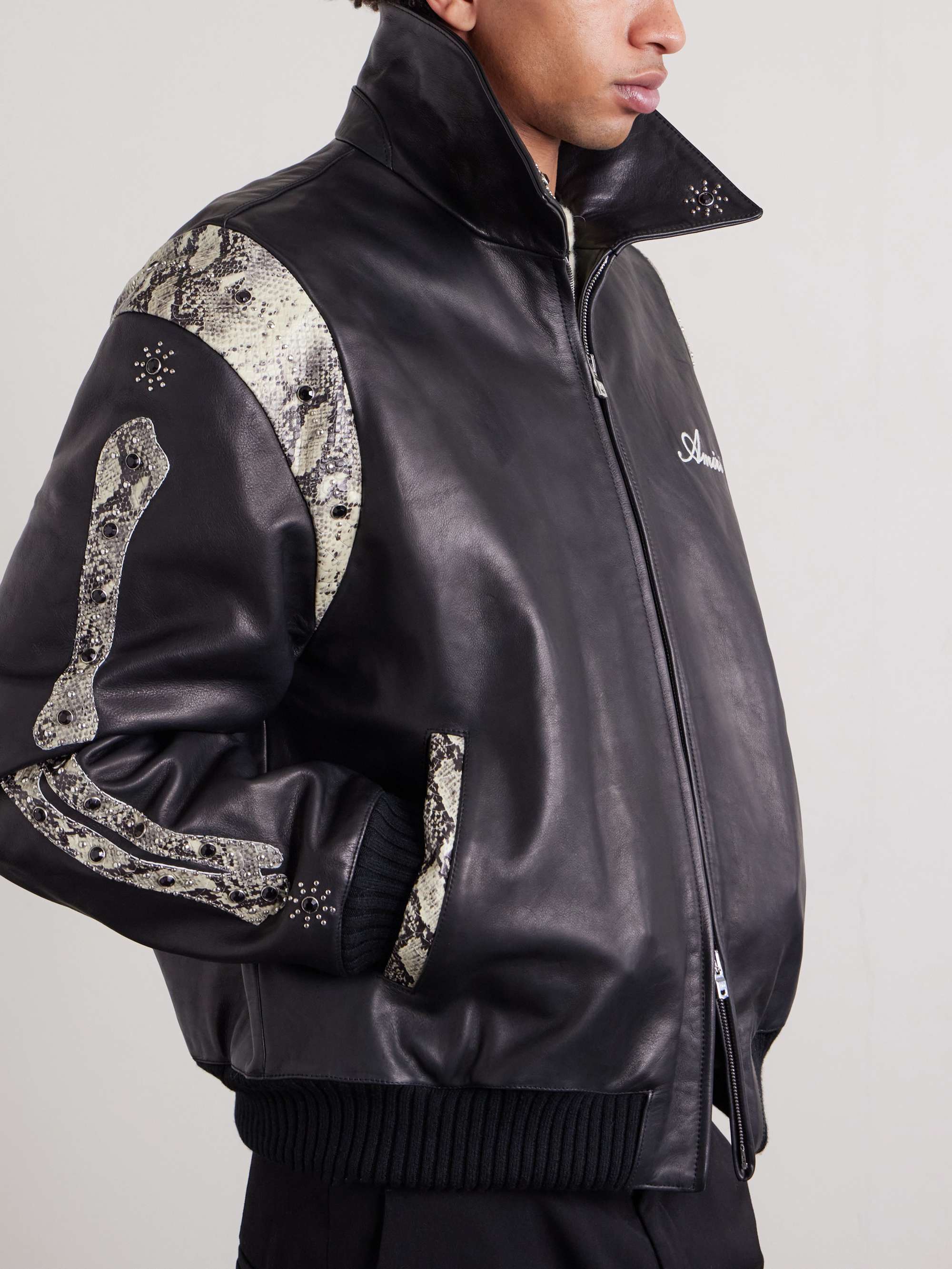
The skeleton motif that defines the sneakers runs through the soft goods too. The Bones Oversized Hoodie, Bones Fleece Zip Hoodie, Bones Stacked Hoodie and a Bones flannel overshirt are all confirmed pieces. The plain option is the MA Core Logo Hoodie, a cotton pullover carrying the MA icon and core logo, described as a normal fit and observed at $650. People constantly conflate the MA Core Logo Tee and the MA Bar Logo Tee, yet they are different products from different countries. Far from a seasonal add-on, flannel is a founding pillar, and the MA Quad Bleached Flannel is observed at $1,290. Wool and leather varsity jackets and denim work jackets take outerwear higher on that same repair logic, but no flagship bomber is supported.
Where AMIRI is actually made
Origin varies by style, so the claim that everything is made in Los Angeles is false. The MX1 jean, the Stack jean and the MA Core Logo Hoodie are made in the United States. The MA Bar Logo Tee is made in Los Angeles specifically, and that covers one product rather than the whole range. The MA Core Logo Tee is made in Italy, which surprises people who assume the jersey follows the denim. Footwear, the Skel Top Low and the Skel Court Hi included, is made in Vietnam. A jean labelled made in Italy, or a Skel-Top labelled made in the United States, is a reason to look harder at the piece.
Observed prices, and discounting that is structural
The figures below are observed market listings read in 2026, not an official price list, and they move. They work as bands, not as fixed points. Tees open around $425, core jeans fall between roughly $750 and $1,100, hoodies go from about $650 into the $900s, and sneakers cluster between $620 and $800. Worked outerwear such as varsity jackets reaches $1,800 to $2,300 and above at list. Rather than being exceptional, discounting is structural, and in-season reductions of 40 to 70 percent appear at authorised multi-brand retailers and off-price channels. That sale floor caps what the secondary market will pay, which is why resale on standard pieces sits below retail.
| Piece | Observed market price | Notes |
|---|---|---|
| Stack | $750 | Entry point into core denim |
| MX1 | $1,090 | Pleated ovine leather set into the repair |
| Baggy MX3, womenswear | $990 | No waistband, motocross hybrid |
| MA Core Logo Hoodie, cotton | $650 | Cotton, normal fit |
| The Skel Top Low | $650 | Signature sneaker per house copy |
| Skel Court Hi, high-top | $690 | Retro-court silhouette in canvas |
| The MA-1 | $799 | Sneaker, not a bomber jacket |
| The Ryder Boot | $1,090 to $1,290 | In leather, suede or python-embossed finishes |
The claims to handle with caution
A surprising share of published AMIRI copy recycles the same errors. The founding year is presented as settled when two sources disagree, store counts are inflated by folding wholesale doors into owned boutiques, and revenue is quoted as audited when it is a founder statement. The most persistent product invention is a tiered MX ladder in which each number means heavier destruction, which reads like search-optimised filler. Promoting treatments to fits, merging footwear names and describing the MA-1 sneaker as a jacket are all common. Finally, there is no official outlet, online or physical. A July 2021 federal complaint carries the company’s statement that it does not have an AMIRI outlet store and has never authorised any person or business to operate one.
- Ask, of any store count, whether it means owned boutiques or wholesale doors.
- Treat named rock clients as secondary-press reports, not brand claims.
- Take Bandana and Crystal for treatments, and MX1, Stack, Thrasher and Shotgun for fits.
- Because origin varies by style, confirm it on the label.
- Take authorised sale prices as the reference point for any resale offer.
Leave a Reply